Home Grown: a 2008 Documentary
This was the official website for Home Grown, a 2008 documentary about the Dervaes family, father, son and two daughters, who run a small organic farm in the heart of urban Pasadena, California.
Content is from the site's 2008 archived pages and other sources.

Since the mid–1980s, members of the Dervaes family have steadily worked at transforming their ordinary city lot in Pasadena into a thriving organic micro farm that supplies them with food all year round. These eco-pioneers also run a successful home business providing their surplus produce to local restaurants.
Through their adventures in growing and preserving their own food, installing a solar power system, home-brewing biodiesel for fuel, raising backyard farm animals, and learning back-to-basics skills, these modern-day pioneers have revived the old-fashioned spirit of self-reliance and resourcefulness.
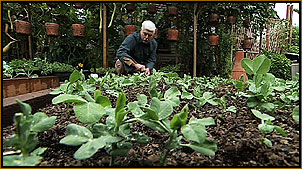
On a quiet street off Orange Grove Boulevard, about a mile from the Rose Bowl and Old Pasadena, members of the Dervaes family pull about 6,000 pounds of edible flowers, vegetables and fruits from the raised beds and pots on their micro-farm each year.
Jules Dervaes and his children Justin, Anais and Jordanne have been growing their own food on their one-tenth of an acre lot since the 1980s. The family produces 99 percent of its entire diet in the family yard in what Jules calls the “100 foot diet,” since produce and eggs travel 100 feet or less from their source to the Dervaes’ kitchen.
The Dervaes’ urban homestead, Path to Freedom, symbolizes a victory in cutting out food miles from their carbon footprint. What makes this feat all the more remarkable is the family’s ability to use water-conserving techniques to grow their produce.
Food miles are “the distance food travels from where it is grown to where it is ultimately purchased or consumed by the end user,” states a paper published for Iowa State University’s Leopold Center for Sustainable Agriculture.… Rich soil is the key to having a bountiful garden and getting the most out of scarce water resources, which is why the Dervaes’ have mulched and composted their soil extensively. Over the years they’ve added so much natural fertilizer to their soil that they now have a foot and a half more soil than their next-door neighbors.
“We don’t waste anything and we have five composting areas around here. When you put the good soil [dirt with animal fertilizer] on the plants they immediately have a kind of insurance against water stress and drought because the soil’s good and the plants have good root systems because they go down,” said Dervaes.
To learn more about conserving water, Jules Dervaes and his family turned to the Internet. Researching old methods of irrigation, they found a system used in ancient China, Rome and Egypt and still used around the world to this day. The system is called “ollas,” the Spanish term for bottle or jar.
Ollas irrigation is based on burying unglazed clay jars in planters or garden beds, near produce, and filling the jars up with water. Unglazed clay pottery leeches moisture, making it a poor container for holding water for long periods of time. When the ollas are buried to the throat in soil, the jar loses water, dripping deep in the soil, near the roots of the plants. It acts as a constant drip irrigation system, but because water is below the surface, it’s not lost in the sun’s evaporating rays and the plants get only the water they need.
(8 April 2010)
Path to Freedom is now the subject of a documntary.
The 21st Century Family FarmHOMEGROWN follows the Dervaes family who run a small organic farm in the heart of urban Pasadena, California. While "living off the grid", they harvest over 6,000 pounds of produce on less than a quarter of an acre, make their own bio diesel, power their computers with the help of solar panels, and maintain a website that gets 4,000 hits a day. The film is an intimate human portrait of what it's like to live like "Little House on the Prairie" in the 21st Century.
|
 |
 |

Homegrown Revolution (Award winning short-film 2009)- The Urban Homestead, Dervaes
An aside: Homegrown is the inspiring true story of the amazing Dervaes family who are living off the grid in the heart of urban Pasadena, California although it's hard to imagine. In fact the concept of growing this much food on such little acreage is mind boggling. I have started a small online business selling dog beds utilizing the left over or seconds of high end fabrics from a printing mill that my wife's family owns. We thought that instead of trashing the fabric it could be used in a constructive manner. The concept is just getting off the ground, but the dog beds look like large round pillows that will coordinate well in a room. Some folks have even mistaken them as large floor pillows rather than what they are: dog beds. I really can't compare what we are doing to what the Dervaes are accomplishing. After all they are an extraordinary family with a message. Their life is not just about growing food, but living in a sustainable manner in an urban setting. We will never be like the Dervaes, but we are trying to make a difference in our own way.
|
HOMEGROWN follows the Dervaes family who run a small organic farm in the heart of urban Pasadena, California. While "living off the grid", they harvest over 6,000 pounds of produce on less than a quarter of an acre, make their own bio diesel, power their computers with the help of solar panels, and maintain a website that gets 4,000 hits a day. The film is an intimate human portrait of what it's like to live like "Little House on the Prairie" in the 21st Century.
Running Time: 52 Minutes
Director's Statement
Many people are becoming aware of the environment. We may have gone to see "An Inconvenient Truth", changed our light bulbs, or started to recycle more. But how many of us are really walking the walk? I know I'm not.
When I heard about the Dervaes family, I sensed that there was a human story behind the headlines about global warming or buying organic produce. I wanted to find out what it takes to live the life of an environmental pioneer. I don't wish to simply glorify or romanticize their way of life, however. I want to show that along with the positive benefits there are also sacrifices. Truly living by your ideals can have costs. I believe that recognizing the hardships the Dervaes have faced makes their work all the more inspiring.
HOMEGROWN is ultimately a family story. It's about what lead them to where they are today, what changed them and what keeps them together. Perhaps by learning of their journey to a sustainable life style, we might be inspired to take our own first steps.
The Dervaes Family (Jules, Anaïs, Justin & Jordanne) Since the mid 1980s, Jules Dervaes and his family have steadily worked at transforming an ordinary residential lot in Pasadena, California into a verdant oasis in the midst of the city. On their small fifth of an acre they are striving to be a self-sustaining urban homestead complete with bio diesel power, solar energy, and wastewater management. These eco-pioneers grow much of their own food and raise a menagerie of chickens, ducks, goats, and an occasional cat. They have been the subject of numerous articles in newspapers around the country, including The New York Times, The Los Angeles Times and were recently featured on ABC's Nightline. You can learn more about them at their website: www.pathtofreedom.com Director/Producer/Editor: Robert McFalls HOMEGROWN is Robert's directorial debut. He is a professional editor with almost twenty years experience in both film and television. While he has worked lately in series television, his first love is the documentary format. Early in his career he was an associate editor on "American Dream", the Barbara Kopple documentary, which won the Academy Award in 1990. That experience helped him to see what a broad reach a well-crafted documentary could have. He recently edited a documentary feature on the Dalai Lama, which is now screening at festivals around the world. Director of Photography: Arthur Yee Arthur Yee is a director of photography with a strong career emphasis in documentary production. In his eight years of experience he has filmed worldwide, shooting various locations from Cambodian street scenes to Bolivian mountain ranges. His photography has been seen in projects airing on PBS, NBC, Discovery Channel, and the History Channel. Composers: Jay Ungar & Molly Mason Jay Ungar and Molly Mason are best known for their haunting composition Ashokan Farewell in Ken Burns' hit PBS series "The Civil War". The soundtrack won a Grammy and Ashokan Farewell was nominated for an Emmy. They've garnered legions of fans through their appearances on "Great Performances", "A Prairie Home Companion", their own public radio specials, and work on film soundtracks such as "Brother's Keeper", "Legends of the Fall", and a host of Ken Burns documentaries. Additional Music: Ted Masur Ted is classically trained musician, with a background that includes conducting, jazz, piano, voice, other instruments and a wide variety of musical influences. Upon completing ASCAP's LA Film Scoring Workshop 2004, Ted was singled out from among fifteen exceptional composers for musical excellence as the recipient of ASCAP's Inaugural Steve Kaplan Award. |
More Background On HomeGrown-Film.com
HomeGrown-Film.com was the official website associated with HomeGrown, a documentary by filmmaker Robert McFalls about one of America's best-known experiments in urban self-sufficiency. Released in 2008 and widely screened during the following several years, the 52-minute documentary follows Jules Dervaes and his adult children Anaïs, Justin and Jordanne as they cultivate an extraordinarily productive urban farm at their family home in Pasadena, California.
At first glance, HomeGrown is a film about gardening. Its subjects grow thousands of pounds of vegetables, fruits, herbs and edible flowers on a residential property surrounded by one of the largest metropolitan areas in the United States. But McFalls was interested in something larger. The documentary examines what happens when a family tries to organize everyday life around principles of self-reliance, conservation and reduced consumption.
The Dervaes family did not simply replace a lawn with vegetable beds. Their experiment eventually incorporated solar power, composting, water conservation, backyard livestock, food preservation and homemade biodiesel. They also turned their small farm into an income-producing enterprise by supplying produce to local restaurants.
That combination of environmental idealism, family dynamics and practical experimentation made HomeGrown particularly timely during the late 2000s, when public interest in climate change, local food, organic agriculture and the environmental costs of the American food system was rapidly expanding.
HomeGrown-Film.com served as the online introduction to that story. The original material described the film as an intimate portrait of a family attempting a kind of 21st-century version of Little House on the Prairie. The site identified the Dervaes family, explained their unusual lifestyle, introduced the filmmakers and gave prospective viewers a way to learn about the documentary.
What Was HomeGrown-Film.com?
HomeGrown-Film.com was created to promote Robert McFalls's documentary rather than the Dervaes family's broader urban-farming organization. That distinction is important.
The Dervaes family maintained its own extensive online presence, originally associated with the Path to Freedom project. HomeGrown-Film.com, by contrast, represented the documentary telling their story.
The surviving material identifies HomeGrown as a 52-minute documentary and Robert McFalls as its director, producer and editor. Arthur Yee served as director of photography. The music included work by Jay Ungar and Molly Mason, with additional music by Ted Masur.
The site introduced visitors to Jules Dervaes and his children Anaïs, Justin and Jordanne and explained how they had converted an ordinary Pasadena residential property into an unusually productive micro-farm.
There is no evidence that HomeGrown-Film.com operated as a large commercial entertainment portal. It functioned primarily as an independent-film website: explaining the film, its subject and its creators and helping build an audience around screenings and environmental-film circles.
Its importance therefore cannot be measured simply by conventional website traffic. The film circulated through festivals, environmental organizations, public screenings and discussions about food and sustainability.
Robert McFalls and the Making of HomeGrown
HomeGrown was Robert McFalls's directorial debut, but he was not a newcomer to filmmaking.
Before directing the documentary, McFalls had accumulated nearly two decades of experience as a professional film and television editor. Earlier in his career, he worked as an associate editor on Barbara Kopple's American Dream, the acclaimed documentary about the Hormel meatpacking strike that won the Academy Award for Best Documentary Feature.
That background helps explain the approach McFalls took with HomeGrown. He did not set out to make an instructional gardening video or a simple piece of environmental advocacy.
His stated interest was the human story behind the headlines about global warming, organic food and sustainable living. He wanted to know what it actually required for people to organize their lives around environmental principles.
McFalls was also explicit that he did not want to romanticize the family. Living according to strong ideals can require sacrifices, and the documentary was intended to acknowledge those costs.
Ultimately, he described HomeGrown as a family story: an examination of what brought the Dervaeses to their unconventional way of life, what changed them and what kept them together.
That perspective gives the documentary an additional dimension. Viewers are not merely shown solar panels, vegetables and biodiesel equipment. They are observing a father and three grown children who have constructed an economic, environmental and family system around a shared project.
The Dervaes Family and the Pasadena Urban Homestead
The setting is one of the most remarkable parts of the story.
The Dervaes property is in Pasadena, California, not in an agricultural valley or remote rural community. The family's current Urban Homestead organization lists its location at 631 Cypress Avenue in Pasadena.
The property is close to some unmistakably urban landmarks. Contemporary accounts emphasized its proximity to the 210 Freeway, while descriptions of the project placed it roughly a mile from the Rose Bowl and Old Pasadena. The contrast was fundamental to the project's appeal: this was intensive food production taking place amid Southern California's freeways, houses and commercial development.
Jules Dervaes Jr. moved his family to Pasadena in the mid-1980s. Over time, the conventional residential property became something radically different.
The lawn disappeared. Food crops filled the available growing space. Composting improved the soil. Chickens, ducks and other small livestock became part of the system. Solar technology reduced dependence on conventional electricity. Recycled cooking oil from restaurants was used to produce biodiesel.
The film's promotional material reported annual production exceeding 6,000 pounds of food from less than a quarter-acre. Some accounts describe the cultivated portion more precisely as approximately one-tenth of an acre.
Those figures were startling enough to become one of the central hooks in media coverage of the family.
From Lawn to Productive Micro-Farm
The transformation did not happen all at once.
A 2004 Los Angeles Times profile described how drought and the cost of maintaining a conventional lawn pushed Jules Dervaes to reconsider the purpose of the family's land. Grass gradually gave way to edible landscaping and eventually intensive food production.
At one stage the family sold edible flowers such as nasturtiums to restaurants. They subsequently expanded into vegetables and other crops.
By the time the project attracted national attention, the property contained a dense assortment of edible plants. Contemporary reporting described basil, thyme, tarragon, onions, beans, eggplants, strawberries and even coffee among the crops.
The family also developed a commercial relationship with restaurants. This was significant because the homestead was not solely an exercise in household gardening. Surplus production generated income.
Restaurants valued the freshness and specialty nature of the produce. Crops could be harvested locally for use by chefs without passing through the long transportation and distribution system typical of conventional agriculture.
The arrangement illustrated one of the project's central ideas: an urban property could potentially become a productive component of a local food economy rather than merely consuming resources.
The “100-Foot Diet” and the Question of Food Miles
One of Jules Dervaes's memorable concepts was the “100-foot diet.”
The idea was simple. Instead of food traveling hundreds or thousands of miles from farm to distributor, supermarket and consumer, some of the family's meals traveled only the distance from their garden to their kitchen.
The project's original materials claimed that the family produced an extremely large proportion of its food from the property and highlighted the dramatic reduction in “food miles” that resulted.
That concept connected HomeGrown to a larger conversation taking place in the 2000s about local food.
Consumers were becoming increasingly aware that environmental impact involved more than whether a food was labeled organic. Transportation, refrigeration, packaging, water consumption, soil health and waste were also part of the equation.
The Dervaes homestead offered an unusually vivid example because many of these issues could be observed within one small residential property.
Solar Energy, Biodiesel and Resource Conservation
Food production was only one component of the family's experiment.
Solar panels helped supply electricity. Cooking oil discarded by restaurants was collected and converted into biodiesel. Compost returned organic material to the soil. Water-saving practices reduced irrigation demands.
The family also experimented with older technologies that had largely disappeared from modern American households.
One example was olla irrigation. Unglazed clay vessels are buried in the soil and filled with water. Moisture gradually passes through the porous clay into the surrounding soil near plant roots, reducing surface evaporation.
These techniques gave the project a distinctive mixture of old and new. Solar panels and internet communication existed alongside compost piles, hand-powered equipment, food preservation and ancient irrigation practices.
That combination was one reason the documentary's comparison with Little House on the Prairie worked so well. The family was not attempting to reproduce the nineteenth century. They were selectively combining traditional practices with contemporary technology.
A Family Story Rather Than a Gardening Manual
One of the strongest contemporary assessments of HomeGrown came from KQED's Bay Area Bites in 2009.
The review emphasized that the documentary reveals both the vision and the enormous amount of work required to produce one's own food. It also drew attention to something easily overlooked when discussing sustainable agriculture: the family itself.
Jules's three adult children continued living and working with their father. Farming, cooking, maintaining equipment, caring for animals and managing the business were shared activities.
The documentary even takes viewers into family business discussions, revealing the tension between environmental principles and the practical necessity of earning money.
That makes HomeGrown less of a gardening tutorial than a portrait of an alternative household economy.
The Cooperative Grocer similarly characterized the film as heartwarming and inspiring but noted that it was principally a story about unusually creative people committed to a cause rather than a step-by-step gardening guide.
Film Festival Screenings and Public Exposure
HomeGrown developed a substantial life on the independent and environmental-film circuit.
In 2008, the film received an advance screening at Lincoln Center's Walter Reade Theater in New York as part of the Green Screens series. It also appeared at the St. Louis International Film Festival.
It was selected for the 2009 Sidewalk Film Festival and San Francisco Documentary Film Festival. KQED listed screenings at the Mill Valley Film Festival and San Francisco Documentary Film Festival in October 2009.
The film also screened in connection with the Vancouver International Film Festival, where audience accounts described an enthusiastic response.
Its reach continued into 2010. The Environmental Film Festival in the Nation's Capital presented HomeGrown at the Smithsonian's National Museum of Natural History in Washington, D.C., as part of a food-and-agriculture program. The festival program described it as a Washington premiere.
The documentary also appeared in the Princeton Environmental Film Festival archive and internationally at the Signes de Nuit festival in Paris.
These screenings demonstrate that HomeGrown reached several overlapping audiences: documentary-film enthusiasts, environmental activists, gardeners, local-food advocates, educators and people interested in alternative approaches to household economics.
HomeGrown and Homegrown Revolution Are Different Films
One potentially confusing aspect of researching HomeGrown-Film.com is the existence of another Dervaes film with an almost identical title.
Robert McFalls's HomeGrown is the approximately 52-minute documentary that was promoted through HomeGrown-Film.com.
Homegrown Revolution is a shorter film created by the Dervaes family themselves.
According to the family's account, the original version of Homegrown Revolution was assembled in only a few days for a lecture Jules Dervaes gave at UCLA in October 2007 on Slow Food. The family members participated in filming, editing and structuring the short despite having little previous filmmaking experience.
The short subsequently became popular online, attracting hundreds of thousands of views and eventually film-festival attention.
The distinction matters when discussing awards.
Contemporary sources describe Homegrown Revolution as an award-winning short film, while Robert McFalls's feature-length HomeGrown had its own festival history. Records also identify McFalls's HomeGrown as a 2010 People's Choice Award recipient at the Wild & Scenic Film Festival.
The similarity of the titles has caused information about the two productions to become mixed together on some later websites.
Media Coverage and Growing Public Interest
The documentary benefited from the fact that the Dervaes family had already become newsworthy.
The Los Angeles Times covered their experiment years before the film's wider festival circulation. A 2004 article portrayed the family as part of Southern California's emerging green movement. Another major Times feature in 2007 explored the practical realities of their Pasadena farm.
National media attention followed. CBS News described Jules and his children in 2009 as pioneers at the forefront of a rapidly growing urban-farming movement.
The family's own historical materials also point to exposure through outlets including ABC's Nightline. Later descriptions of the Urban Homestead cite appearances or coverage involving CNN, Oprah, People, the Sundance Channel and National Geographic.
This broader publicity helped give HomeGrown an audience beyond the normal independent-documentary circuit. People could encounter the Dervaeses through television, newspapers or environmental reporting and then discover the documentary as a more intimate examination of their lives.
Reviews and Audience Response
HomeGrown never became a mass-market theatrical blockbuster, and the available number of conventional consumer reviews is relatively small. That is typical of independently distributed environmental documentaries.
Nevertheless, the surviving reaction is strongly favorable.
IMDb lists the film at 8.1 out of 10, although the rating is based on only 20 votes and therefore should not be interpreted as a broad scientific measure of audience opinion.
More revealing are contemporary reviews and festival commentary.
KQED described the documentary as an intimate portrait and emphasized its willingness to show the complicated relationship between family, business and ecological principles. The Cooperative Grocer recommended it as an inspiring example of urban self-reliance.
Writing about the Vancouver International Film Festival, one attendee reported enthusiastic applause and audience members exchanging information about the Dervaes project afterward.
Another contemporary review strongly recommended the film while observing that its 52-minute running time still managed to raise larger questions about work, consumption, security and the meaning of independence.
The common theme is inspiration without the assumption that every viewer should imitate the Dervaeses completely.
Popularity and the Internet's Role
The Dervaes family's internet presence was itself part of the story.
Promotional descriptions of HomeGrown said that the family's website was receiving approximately 4,000 hits per day. In an era before today's social-media ecosystem fully developed, a specialized sustainability website attracting that level of attention represented meaningful grassroots visibility.
The web enabled the Dervaeses to document techniques, communicate their philosophy and reach people far beyond Pasadena.
It also helped transform a single family's backyard experiment into something that could participate in a wider movement.
HomeGrown-Film.com operated within that same early web environment. A documentary about a family made famous partly through online communication had its own website through which trailers, descriptions and screening information could circulate.
Cultural and Social Significance
The timing of HomeGrown was particularly important.
The late 2000s produced an extraordinary wave of interest in the American food system. Concerns about climate change, food transportation, industrial agriculture, energy consumption and economic vulnerability were entering mainstream discussion.
Films such as Food, Inc., King Corn, Fresh and Dirt! The Movie contributed to this cultural moment.
HomeGrown approached many of the same concerns from an unusually intimate direction.
Instead of beginning with industrial farms or national food policy, it began with one house.
What happens if the lawn becomes a farm?
What happens if kitchen and garden waste become compost?
What happens if used restaurant oil becomes vehicle fuel?
What happens if adult children and their father build a livelihood together instead of organizing their lives around conventional jobs and consumption?
The Dervaeses did not provide universally applicable answers, but they created an unusually concentrated demonstration of what could be attempted within an urban environment.
Controversy and a More Complete Historical Picture
The family's later history also deserves mention because the cultural legacy of the Urban Homestead was not entirely without controversy.
In 2010, Jules Dervaes obtained federal trademarks involving the phrases “Urban Homestead” and “Urban Homesteading.” Subsequent efforts to enforce those trademarks against other writers and organizations generated substantial criticism within the very sustainability community that had previously celebrated the family's work.
The Los Angeles Times reported on the dispute in 2011, noting that critics argued the terminology had been used by others for decades.
This controversy occurred after the period primarily documented in McFalls's film, so it should not be retroactively treated as the subject of HomeGrown. Nevertheless, it forms part of the larger history of the Dervaes project and illustrates how influential the terminology surrounding urban homesteading had become.
The Urban Homestead Today
Jules Dervaes died in 2016, but the Pasadena farm did not disappear.
Anaïs, Justin and Jordanne continued the project, and a major Los Angeles Times feature in 2024 revisited the property nearly four decades after their father's experiment began.
The family had expanded food production onto a nearby property. They continued supplying produce and developed educational programs, workshops and other activities.
Today, the Urban Homestead describes itself as a regenerative urban family farm and community-education project. Its Farm Box program serves approximately 150 to 200 families, while internships, tours and workshops introduce participants to regenerative gardening and homesteading skills.
The organization reports thousands of hours of farm internship experience and substantial food donations, while continuing to work with schools, students and community groups.
That longevity gives HomeGrown an unusual quality when viewed today. Many documentaries capture a short-lived experiment. This one captured a project that was still operating decades later.
What HomeGrown-Film.com Is Best Remembered For
HomeGrown-Film.com is best understood as the digital home of a small independent documentary attached to a much larger cultural story.
The film's immediate attraction was the astonishing productivity of the Pasadena property: thousands of pounds of food coming from land most urban homeowners would regard as a small yard.
But its deeper subject was self-reliance.
The Dervaes family questioned assumptions about where food must come from, how much land agriculture requires, how households use energy, what constitutes waste and how closely everyday behavior can be aligned with environmental convictions.
Robert McFalls wisely framed those questions through people rather than statistics. The resulting film is not simply a catalog of sustainable techniques. It examines the labor, commitment, family relationships and compromises involved in trying to live according to an ideal.
More than fifteen years after the documentary's festival run, those questions have arguably become more relevant rather than less. Urban agriculture, regenerative growing, food security, drought, local supply chains, composting, renewable energy and household resilience are now common topics in environmental planning.
The Pasadena property documented in HomeGrown offered an unusually early and highly visible demonstration of how many of those ideas could intersect in one place.
For visitors encountering HomeGrown-Film.com today, the website therefore represents more than an archived promotional site for an obscure 2008 documentary. It is a surviving window into a particular moment when urban farming and modern homesteading were moving from the margins toward mainstream environmental culture.
The film documented that transition through one extraordinary Pasadena household—and, in doing so, preserved the human story behind an experiment that is still continuing today.